How to choose sneakers: fit, sole, material and use
Wondering how to choose sneakers that still feel good at the end of a long day? Most people pick a pair they like in their usual size, yet it is the fit, the sole and the material that decide how comfortable they will be. This guide covers what matters, from how you will use them to the five checks to make when you try them on.
How to choose sneakers: start with how you will use them
The first question is not the brand or the colour but the use. A pair you wear all day around the city needs different qualities from a pair for the office or the weekend. Knowing this before you walk into a shop makes the choice quicker and better.
- Everyday and in the city. You walk a lot, on cobblestones, pavements and tram tracks. Look for a rubber sole with good grip, decent cushioning and an upper that can handle a shower.
- At work. A plain leather sneaker in white, black or navy goes with chinos or smart trousers in many offices.
- Weekends and travel. Lightness and ease come first: a pair you can slip on and off quickly, that fits in a suitcase and works with jeans as well as shorts.
- Sport. For running, gym sessions or ball sports, choose a shoe designed for that activity. A lifestyle trainer is made for walking and everyday comfort, not for intensive exercise.
Fit and width
Your usual size is a starting point, not a guarantee. Sizes vary from brand to brand, and sometimes between models from the same brand. To convert between EU, UK and US sizes, see our shoe size conversion chart.
Length
In front of your longest toe you need roughly a finger’s width of space. Without it, your toes hit the front of the shoe with every step; with much more, your foot slides forward. Note that your longest toe is not always your big toe.
Width
You feel the width at the ball of the foot, the broad part just behind the toes. Nothing should pinch there, and the upper should not bulge over the sole. Some models are cut narrower than others. If a pair in your size feels tight, try a different model before going up a size, or the shoe will end up too long.
Heel and instep
The heel should be held firmly and must not slip out as you walk. Laces let you adjust the fit over the instep precisely; a slip-on or elasticated model is more convenient but less adjustable.
Sole and cushioning
The sole decides how a sneaker feels and how long it lasts. On most models it has two layers: an outsole that touches the ground and a midsole that absorbs impact.
The outsole
Rubber gives the best grip and wears slowly, even on wet cobbles. Fine grooves or studs help in the rain; a completely smooth sole looks sleek but is slippery on damp stone.
Midsole and cushioning
Lightweight foam midsoles make a sneaker flexible and soft underfoot, which you notice after a long day on your feet. They do, however, wear faster than rubber if you walk a lot.
The insole
A removable insole is useful if you wear your own insoles; bring them along when you try shoes on. If you have foot problems, see a doctor or podiatrist, who can tell you which type of shoe suits you.
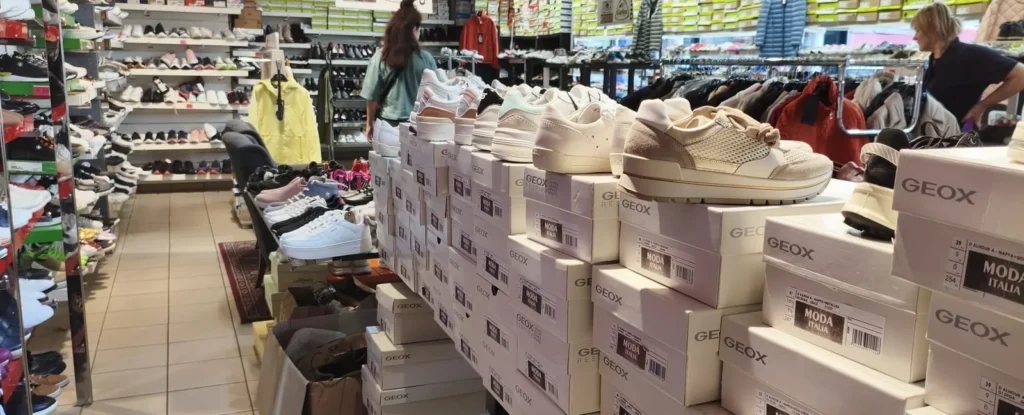
Some brands are known for a particular quality. Geox is known for its breathable sole, Ecco for supple leather and comfort over long days.
Materials
The upper decides how a sneaker looks, how it copes with rain and how much care it needs. At a glance:
| Material | Strength | Watch out for | Ideal for |
|---|---|---|---|
| Smooth leather | Sturdy, softens within a few days, long-lasting | Regular polishing and conditioning | Work, city, every day |
| Suede and nubuck | Soft touch, warm look | Sensitive to water and stains; waterproof before wearing | Dry days, weekends |
| Textile and mesh | Light and breathable | Lets water through faster | Spring, summer, travel |
| Synthetic | Light and easy to clean | Less breathable, sometimes wears faster | Occasional use |
Leather and synthetic can look very alike. The label inside the shoe uses pictograms to show the material of the upper, lining and outsole. Our guide to real leather versus synthetic explains how to tell them apart by sight and touch.
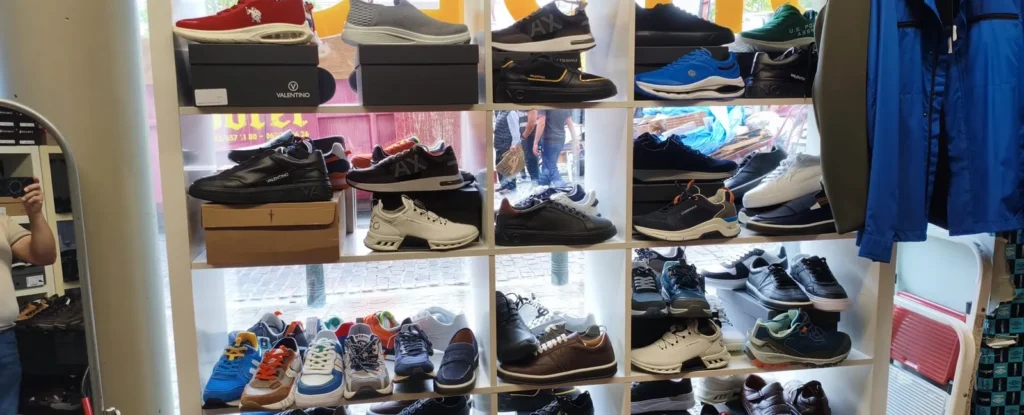
For a more distinctly Italian look, turn to Voile Blanche and Valentino; Geox and Ecco are chosen more for comfort. Our overview of the sneaker outlet in Brussels introduces each brand.
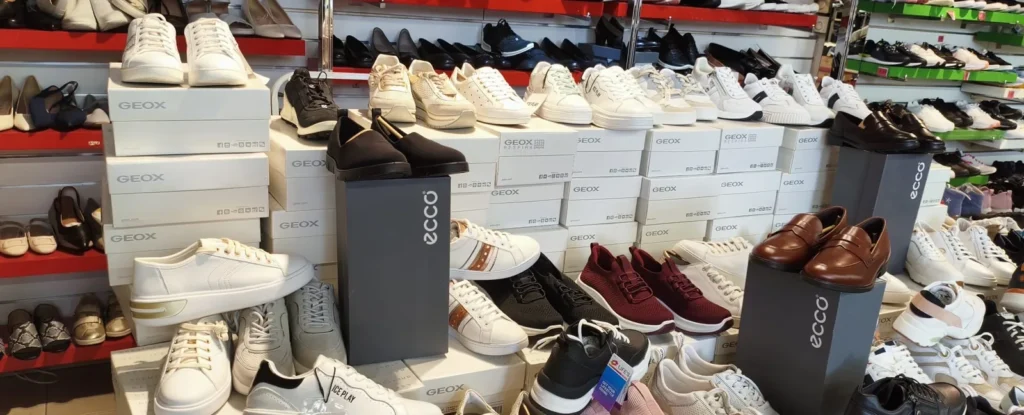
Trying them on in the shop: five checks
A photo cannot show you the fit. In a shop you take two sizes and two models and compare in minutes what would take days of returns online. Make these five checks, wearing the socks you will actually wear.
- Length. Press the toe with your thumb: in front of your longest toe you should feel roughly a finger’s width of space.
- Width. At the ball of the foot nothing pinches and the upper does not bulge.
- Heel. Take a few steps: the heel stays in place and does not rub.
- Flex point. Stand on tiptoe: the shoe bends where your foot bends, without the edge pressing into your toes.
- Walk. Always try both shoes and walk a few metres. If you feel a seam, a pressure point or a loose heel, try another size or another model.
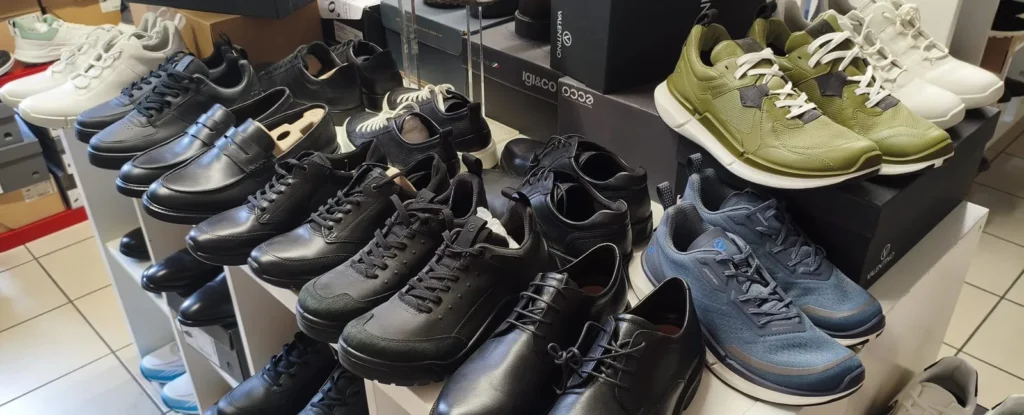
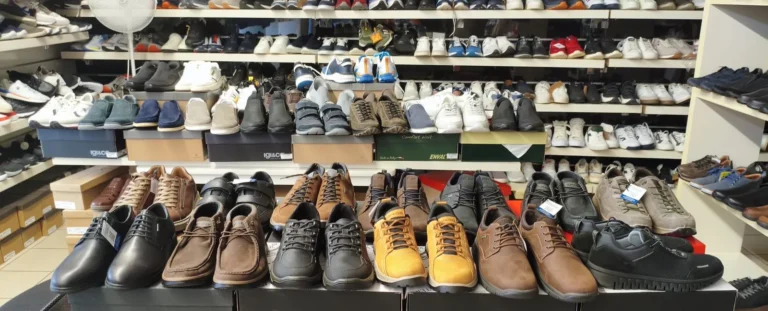
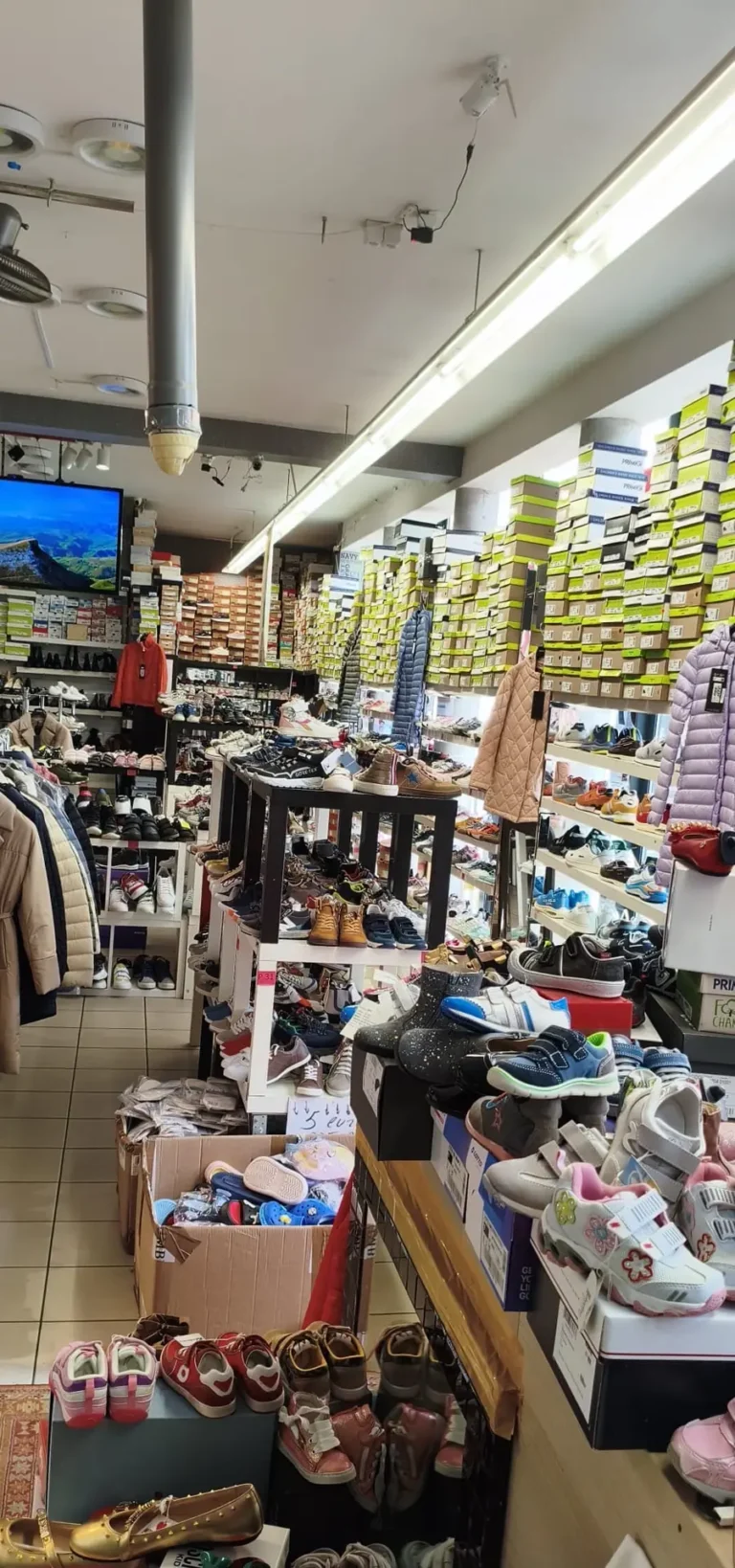
With us, you can make these checks at your own pace. The shelves are packed with sneakers for women, men and children, in a very wide range of sizes and styles, from Geox and Ecco to Voile Blanche and Valentino. Our sneakers and trainers page gives you an idea of what we stock.
We buy in bulk in Italy, directly from large retail chains, and sell these new shoes in their original boxes at fixed outlet prices, from about €20 to €150. Those prices apply all year round, so there is no need to wait for a particular moment to choose well.
So come and try them on: you will find us at 40 Place du Jeu de Balle in the Marolles, every day from 9.30 am to 4 pm, Sundays included. In the morning you can combine your visit with the flea market on the square. Directions are on our shop and getting here page.
Frequently asked questions
How much room should there be at the front of a sneaker?
About a finger’s width in front of your longest toe. That space lets your foot move as you walk without sliding forward. Check it standing up, wearing the socks you usually wear.
Can I run or do sport in everyday sneakers?
For a walk or daily wear, yes. For running, gym sessions or ball sports, a shoe designed specifically for that activity is the better choice. If you have foot problems, see a doctor or podiatrist.
Are leather or textile sneakers better for Brussels rain?
Leather copes better with a shower, especially if you look after it regularly. Textile and mesh are lighter and breathable but let water through faster. Suede and nubuck are best treated with a waterproofing spray before you wear them for the first time.
Can I come and try on sneakers on a Sunday?
Yes. Our shop on Place du Jeu de Balle in Brussels is open every day from 9.30 am to 4 pm, Sundays included. We do not sell online: you try on and choose in the shop.