Buying kids’ shoes: measuring size, growing room and when to replace them
This children’s shoe size guide shows you how to measure your child’s feet at home with a sheet of paper, a pencil and a ruler. You will find out how much growing room a child’s shoe needs and how often to check the size again. We also explain when to replace a pair and what to look for from first steps to sport.
Children’s shoe size guide: measuring at home
Children rarely say their shoes are pinching, and the size in the old pair is often already too small. So measure the foot itself. It only takes a few minutes:
- Lay a sheet of paper flat on a hard floor, against a wall.
- Have your child stand up straight on the paper, heel against the wall, weight on both feet, wearing the socks they will wear with the shoes.
- Holding the pencil upright, draw a line just in front of the longest toe. That is not always the big toe.
- Trace the outline of the foot as well.
- Measure the distance from the wall to the line in centimetres, then repeat everything with the other foot.
Keep the longer of the two measurements. Ideally, measure at the end of the day, when feet are usually slightly larger than in the morning. With a toddler it is easier with two people: one keeps the child calm, the other draws.
With that length in centimetres, look up the matching size in our kids’ shoe size conversion chart. Then cut out the outline: this paper template will come in handy in the store.
How much growing room
A child’s shoe should leave some space beyond the longest toe: roughly a thumb’s width, or about one to one and a half centimetres. The foot slides forward slightly with every step, and the extra space gives your child a few months to grow. Always check it with the child standing in the shoe, never sitting down.
Too much room is no better: in a shoe that is clearly too big, the heel slips and a child walks less steadily. So avoid buying a size up “to grow into”.
Once the shoe is on, there are three ways to check the growing room:
- The thumb test: press your thumb on the toe of the shoe and feel where the longest toe is.
- The insole test: take out the removable insole and have your child stand on it.
- The paper template: slide the cut-out outline into the shoe. It should lie flat and leave space in front of the toes.
Check the width too. If the paper template curls up at the sides, the model is too narrow, even if the length is right. Every brand uses its own last, so a different model may fit better.
How often to check
Children’s feet grow in spurts. A fixed routine helps: set a reminder in your calendar and measure again. The table gives a rule of thumb; every child grows at their own pace.
| Age | Check (rule of thumb) | What to look at |
|---|---|---|
| 1 to 3 years | every 2 months | room in front of the toes |
| 3 to 6 years | every 3 months | growing room and fastening |
| 6 to 12 years | every 4 months | growing room, sole and heel |
| from 12 years | every 6 months | length, width and wear |
When to replace them
Whatever the routine, these signs show that a pair has had its day:
- the thumb test leaves no room in front of the longest toe;
- your child kicks the shoes off quickly or walks differently in them;
- you notice red pressure marks on the toes or heel;
- the sole is worn unevenly or the tread has gone smooth;
- the heel counter has collapsed or the fastening no longer holds.
Hand-me-downs from an older brother or sister are tempting, but a worn shoe has taken on the shape of the previous foot. If discomfort persists or you are unsure about the way your child walks, consult a doctor or podiatrist.
First steps, school, sport
The measurement stays the same, but the right model depends on the use.
First steps
A child who is just learning to walk will be comfortable in a light shoe with a flexible sole that bends easily at the toes. Choose a fastening that holds the foot securely, with touch-fasten straps or laces, and a firm heel counter.
School
For school, sturdiness matters: a toe that can take a knock, a sole with good tread and a fastening your child can do up alone. For rainy Brussels mornings, water-repellent leather is a good choice, with a lined model in winter. You will find more tips in our article on back to school shoes.
Sport
For the playground and PE lessons, light trainers with a flexible sole are enough. Check the growing room carefully, as running pushes the foot forward. A smart pair for a party is worn less often, so check the size again shortly before the occasion.
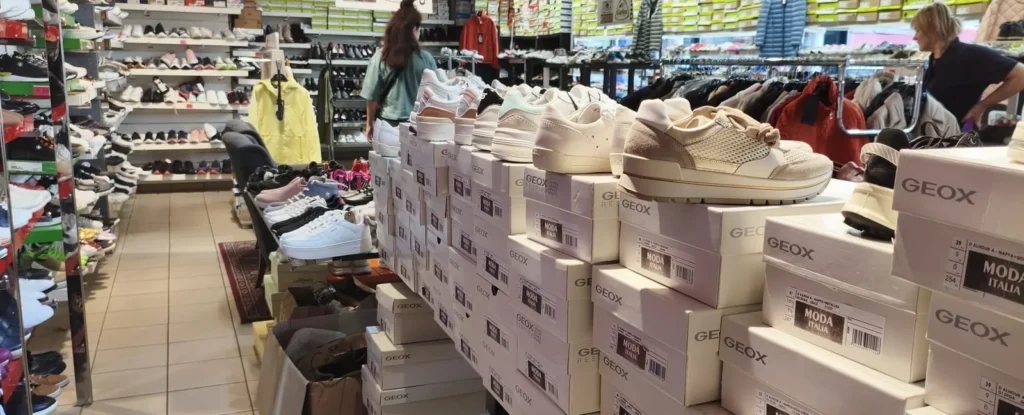
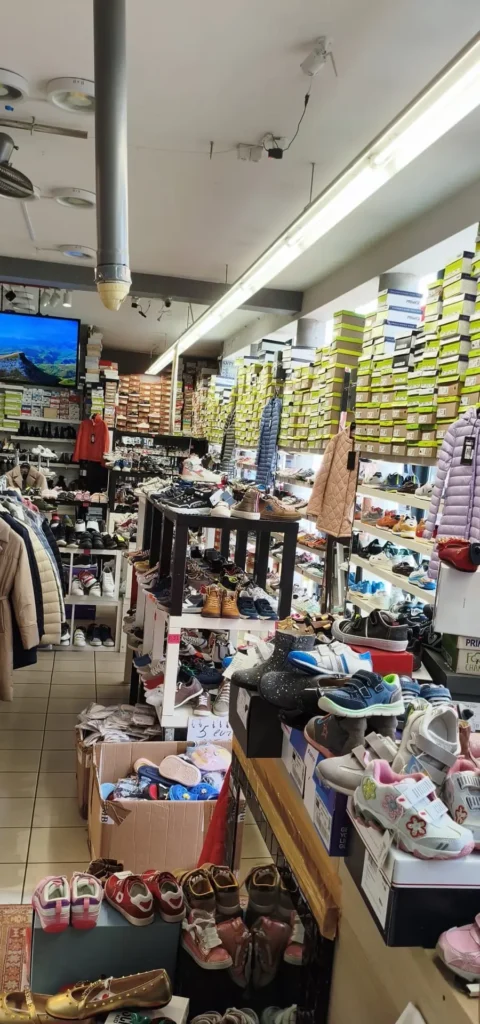
In our store you will find children’s shoes from the Italian brands Naturino and Primigi, as well as Geox. Read more in our article on Naturino and Primigi at outlet prices.
Trying shoes on in the store
Measuring at home is a good starting point, but the decision is made with the shoe on the foot. So bring your child along to 40 Place du Jeu de Balle, in the Marolles. We are open every day from 9.30 am to 4 pm, Sundays included, so Wednesday afternoons and weekends work too. Our store and directions page explains how to get here.
Bring the paper template and your child’s usual socks. Let your child put on both shoes, fasten them and walk a few laps. Then do the thumb test and check that the heel does not slip. Ask your child how the shoes feel, too: a shoe they like is a shoe they will actually wear.
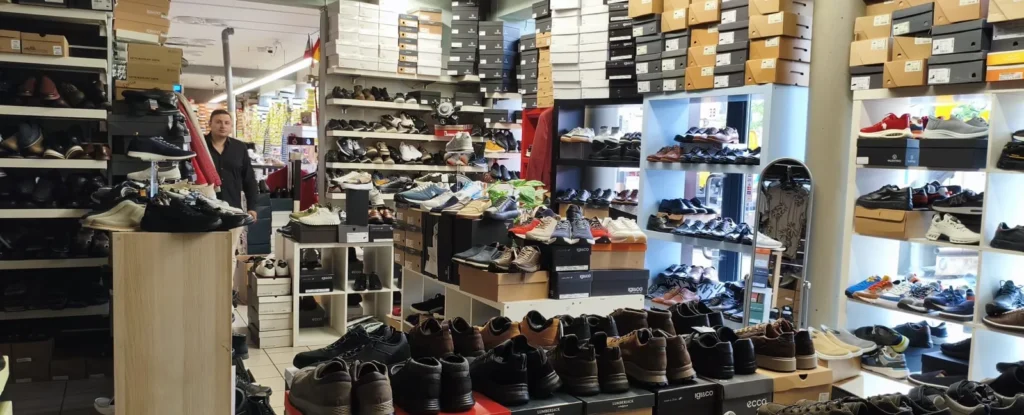
Because we buy in bulk in Italy, directly from large chains, many models are on our shelves in a long run of sizes. That means you can compare the size from the chart with the one next to it. These are new shoes in their original box, at fixed outlet prices from about €20 to €150, all year round. Browse our children’s shoes section and our article on the kids’ shoe outlet in Brussels.
Frequently asked questions about children’s shoe sizes
How much growing room should a child’s shoe have?
Allow roughly a thumb’s width between the longest toe and the end of the shoe, about one to one and a half centimetres. Always check it with the child standing up. More room is not better: in a shoe that is too big, the foot slides around.
How often should I check my child’s shoe size?
As a rule of thumb, every 2 months up to age 3, every 3 months up to age 6 and every 4 months up to age 12. After that, every 6 months is usually enough. Also watch for signs such as red marks or shoes that come off quickly.
Should I buy children’s shoes a size bigger?
A thumb’s width of growing room is already built into the right choice; a whole size more is usually too much. In a shoe that is too roomy, the heel slips up and down. If you are torn between two sizes, try them side by side in the store.
How can I tell if my child’s shoes are too small?
If the thumb test shows the longest toe pressing against the end, the pair is too small. Red marks on the toes or heel are another clear sign. Measure again and come in to try the next size.